
1. CONCERT TOUR in the Netherlands - Wat het Hart Doorboort
WAT HET HART DOORBOORT / THE HEART UNDONE
The experiences of loss, love, anger, triumph, or even peace can create strong emotions, in Italian, affetti. The concept of affetti, derived from ancient rhetoric and poetic theory, became central to Renaissance art theory where human passion and feelings were conveyed through movement, gesture, art and music. Trying to capture affetti in music composers turned to writing monody: the solo voice accompanied by one or more instruments. Each text set to music had one or more distinct affetti and the musician becomes an actor, stepping into the skin of the protagonist to transmit their passions to the listener in a way so effective they are powerless to resist change in their own emotional state.
It is through music that these passions pierce the heart, “for rhythm and harmony”, as Plato states, “find their way to the most inward places of the soul”.
By bending or breaking compositional “rules” or best-practices that reigned throughout the Renaissance, composers musically intensified the emotions suggested in the text. In every piece of the program, the listener may recognize themselves, for the passions and affections that flow through it are shared by every soul that feels.
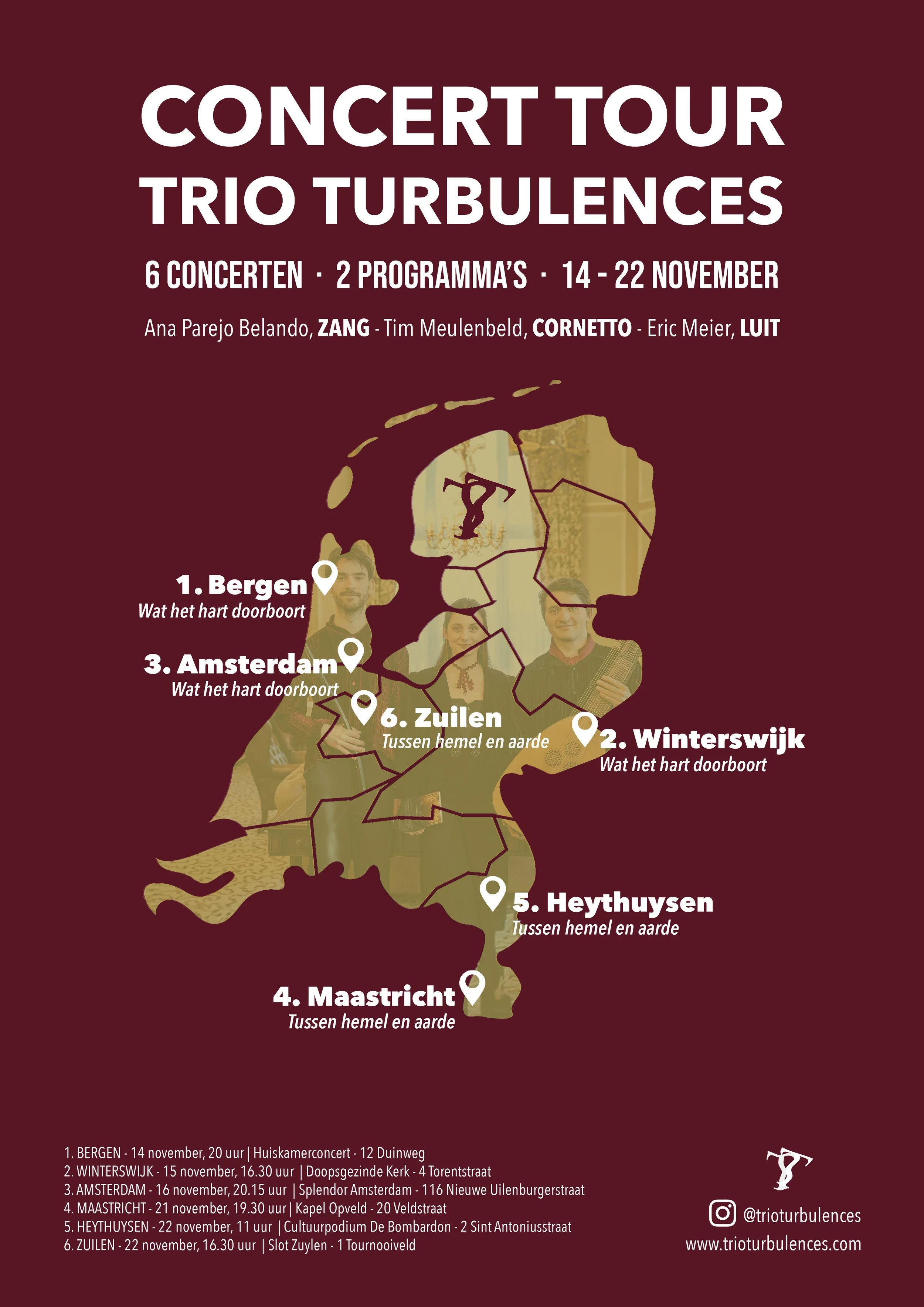
2. CONCERT TOUR in the Netherlands - Wat het Hart Doorboort
WAT HET HART DOORBOORT / THE HEART UNDONE
The experiences of loss, love, anger, triumph, or even peace can create strong emotions, in Italian, affetti. The concept of affetti, derived from ancient rhetoric and poetic theory, became central to Renaissance art theory where human passion and feelings were conveyed through movement, gesture, art and music. Trying to capture affetti in music composers turned to writing monody: the solo voice accompanied by one or more instruments. Each text set to music had one or more distinct affetti and the musician becomes an actor, stepping into the skin of the protagonist to transmit their passions to the listener in a way so effective they are powerless to resist change in their own emotional state.
It is through music that these passions pierce the heart, “for rhythm and harmony”, as Plato states, “find their way to the most inward places of the soul”.
By bending or breaking compositional “rules” or best-practices that reigned throughout the Renaissance, composers musically intensified the emotions suggested in the text. In every piece of the program, the listener may recognize themselves, for the passions and affections that flow through it are shared by every soul that feels.
3. CONCERT TOUR in the Netherlands - Wat het Hart Doorboort
WAT HET HART DOORBOORT / THE HEART UNDONE
The experiences of loss, love, anger, triumph, or even peace can create strong emotions, in Italian, affetti. The concept of affetti, derived from ancient rhetoric and poetic theory, became central to Renaissance art theory where human passion and feelings were conveyed through movement, gesture, art and music. Trying to capture affetti in music composers turned to writing monody: the solo voice accompanied by one or more instruments. Each text set to music had one or more distinct affetti and the musician becomes an actor, stepping into the skin of the protagonist to transmit their passions to the listener in a way so effective they are powerless to resist change in their own emotional state.
It is through music that these passions pierce the heart, “for rhythm and harmony”, as Plato states, “find their way to the most inward places of the soul”.
By bending or breaking compositional “rules” or best-practices that reigned throughout the Renaissance, composers musically intensified the emotions suggested in the text. In every piece of the program, the listener may recognize themselves, for the passions and affections that flow through it are shared by every soul that feels.
4. CONCERT TOUR in the Netherlands - Tussen hemel en aarde
TUSSEN HEMEL EN AARDE / BETWEEN HEAVEN AND EARTH
Music through its secular, mythological and spiritual aspects has made man to look to the sky and ponder his earthly state.
In secular music, we see the base aspects of earthly love and nature. Mythology recounts the presence and influence of the gods on Earth, equally susceptible as mortals to human desires. In contrast, spiritual music portrays the heavens as a place of perfection.
Humanist writers reunited these three states through love; earthly desire carried also a spiritual state and the apparent opposition between Heaven and Earth disappears.
5. CONCERT TOUR in the Netherlands - Tussen hemel en aarde
TUSSEN HEMEL EN AARDE / BETWEEN HEAVEN AND EARTH
Music through its secular, mythological and spiritual aspects has made man to look to the sky and ponder his earthly state.
In secular music, we see the base aspects of earthly love and nature. Mythology recounts the presence and influence of the gods on Earth, equally susceptible as mortals to human desires. In contrast, spiritual music portrays the heavens as a place of perfection.
Humanist writers reunited these three states through love; earthly desire carried also a spiritual state and the apparent opposition between Heaven and Earth disappears.
6. CONCERT TOUR in the Netherlands - Tussen hemel en aarde
TUSSEN HEMEL EN AARDE / BETWEEN HEAVEN AND EARTH
Music through its secular, mythological and spiritual aspects has made man to look to the sky and ponder his earthly state.
In secular music, we see the base aspects of earthly love and nature. Mythology recounts the presence and influence of the gods on Earth, equally susceptible as mortals to human desires. In contrast, spiritual music portrays the heavens as a place of perfection.
Humanist writers reunited these three states through love; earthly desire carried also a spiritual state and the apparent opposition between Heaven and Earth disappears.
Festival FestiVita! - Los tres de empezar: La viuda valenciana
Los Tres de Empezar: La Viuda Valenciana
Inspiré par la pratique des cuatros de empezar, un élément caractéristique du théâtre espagnol du XVIIe siècle, Trio Turbulences réunit des tonos, choisis pour leurs qualités poétiques, afin d’illustrer en musique l’histoire de La Viuda Valenciana. Le programme met en lumière la pratique naissante de l’accompagnement à la guitare baroque, un instrument dont la couleur était intrinsèquement liée à la musique populaire, mais qui commençait à s'imposer dans l'accompagnement des œuvres de la cour et du théâtre.
À cette époque, le théâtre espagnol faisait appel à de courtes pièces musicales à quatre voix, interprétées au début et à la fin de la représentation, appelées respectivement cuatros de empezar (« quatuors d’ouverture ») et cuatros de terminar (« quatuors de clôture »). Ces pièces musicales, combiné avec des danses et chansons populaires servaient à introduire et à ponctuer la représentation théâtrale. De plus, la musique figurait au sein d’une pièce de théâtre. Des moments ou émotions clés étaient soulignés par de la musique chanté, provenant de musiques populaires connues, ou spécialement écrite pour l’occasion. Le programme élargit le rôle traditionnel des musiciens de théâtre : au-delà du divertissement, la musique devient un véritable fil narratif, portant l’histoire et donnant vie aux intrigues, aux passions et aux émotions de la pièce.
Dans La Viuda Valenciana (La Veuve valencienne), Lope de Vega raconte l’histoire de Leonarda, une jeune veuve fortunée, déterminée à préserver son indépendance et à résister aux pressions du remariage. Lorsqu’elle tombe amoureuse du galant Camilo, elle organise secrètement leurs rencontres, le recevant dans l’obscurité afin qu’il ne puisse découvrir son identité. À mesure que leur passion grandit, Leonarda doit dissimuler leur relation pour préserver son honneur et sa réputation, dans une société façonnée par les idéaux chrétiens de vertu et de modestie féminines. À travers ce jeu de secret et de désir, Lope de Vega explore l’ingéniosité d’une femme qui cherche à vivre son amour selon ses propres règles, tiraillée entre passion intime et exigences des apparences sociales.